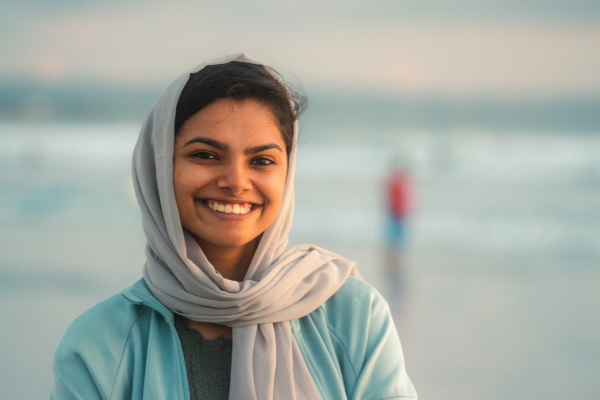
Welcome Shahma !
Shahma Subair will be joining the University of Liege in October 2025 as a Doctoral Candidate.
In the framework of the MonaLisa project, Shahma will spend 3 years working on ” Development of an integrated platform for single-molecule force spectroscopy experiments under external stimulus “, while participating in many trainings and network events.
Read the following introduction to get to know her:
Tell us more about your background!
I’m a 24-year-old physicist with a background that’s more mixtape than monotone. Born in the lush green district of Malappuram, Kerala, India, and raised in the industrial port city of Jubail, Saudi Arabia, I’m equally at home with downpours and sandstorms. I graduated in 2024 from the Indian Institute of Science Education and Research (IISER), Thiruvananthapuram, with a BS-MS in Physics (and minor in Chemistry).
Why do you want to be part of MonaLisa?
MonaLisa’s science felt tailor-made for my dual degree in Physics and Chemistry, but its collaborative structure sealed the deal. It’s not just an opportunity to conduct research, but to grow within a dynamic MSCA network that includes Nobel Laureates and prioritizes professional development over working in a silo. The prospect of joining 14 other talented PhDs to tackle huge challenges together is fascinating.
What are your expectations of living and working in Liege?
While my actual research will focus on single-molecule force spectroscopy, I’m also determined to carry out an informal, multi-year study on the structural integrity of Belgian waffles. I’m excited to experience Liège’s mix of historic charm and vibrant student life, improve my French one croissant at a time, and become part of a collaborative, international lab culture. And, of course, I’m hoping to use Liège as a launchpad to explore as much of Europe as possible.
What do you think will be your main challenge for you in the next three years?
I see my main challenges in a few layers. The most immediate is the technical one: learning AFM from scratch and convincing single molecules to behave. Then there’s the logistical puzzle of balancing that intense research with the equally important goal of exploring Europe.
But the ultimate challenge, I suspect, will be internal: battling what I’ve heard is the final boss of every PhD program—Imposter Syndrome. Learning to navigate that will likely be as crucial as any successful experiment.

