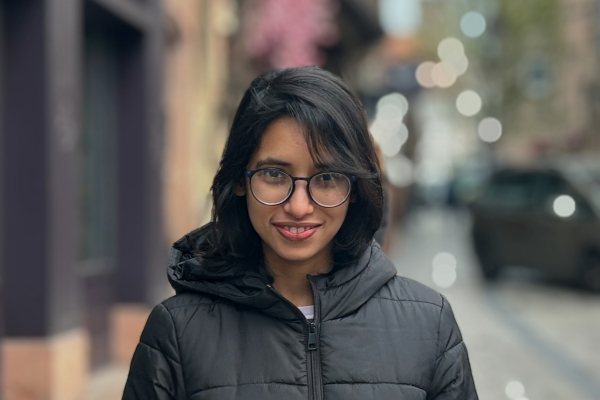
Welcome Labonno !
Labonno Azad will be joining SYENSQO in December 2025 as a Doctoral Candidate.
In the framework of the MonaLisa project, Labonno will spend 3 years working on “Artificial Molecular Motors for Controlling Microfluidic Flows” while participating in many trainings and network events.
Read the following introduction to get to know her:
Tell us more about your background!
I am 28 years old and from a small suburb of Bangladesh. After completing my higher secondary education, I moved to the capital of my country and completed my bachelor’s in chemical engineering from Bangladesh University of Engineering and Technology (BUET). I later joined the Erasmus Mundus Joint Master’s Programme “BioRef” with a full scholarship, where I studied across Italy, Poland, and France. For my final master’s internship, I worked at ICS, CNRS, focusing on nanocomposites and thin film fabrication.
Why do you want to be part of MonaLisa?
MonaLisa offers an ideal blend of technical training and personal development. Working on artificial molecular motors is a fascinating research opportunity, and the programme’s interdisciplinary and diverse network will allow me to collaborate with researchers from different backgrounds while sharing knowledge through conferences and publications. What excites me most is MonaLisa’s mission to translate fundamental discoveries into real-world applications in materials, medicine, and energy, which aligns perfectly with my academic background and long-term goals.
What are your expectations of living and working in Bordeaux (and Strasbourg) ?
Since my work will take me to both Strasbourg and Bordeaux, I am especially excited to experience the unique character of each. Strasbourg, with its international outlook and cultural diversity, already feels welcoming and familiar, while Bordeaux, with its vibrant atmosphere and proximity to the coast, promises a different charm. I look forward to exploring both cities, meeting new people, and enjoying their culture, history, and food alongside my research journey.
What do you think will be your main challenge for you in the next three years?
I think one of the main challenges of a PhD is learning how to face setbacks and approach problems from different angles. I believe that staying open to new ideas and remaining resilient in the face of failure is the key to overcoming challenges. Another aspect of my PhD is mobility, which makes the programme exciting but also brings its own challenges. Moving between cities means adjusting to new environments, finding accommodation, and sometimes re familiarizing myself with instruments after a break, all of which can be demanding

